 Duluth Water Leak Detection Pros
Multiple or Recurring Leaks: When One Leak Is Not the Whole Story
Multiple or recurring leaks in Duluth, GA, in ZIP codes 30096 and 30097, usually mean a system question, not bad luck. A second leak, or a leak that returns after repair, points to material, pressure, or a missed source. Finding that pattern matters more than fixing the latest spot.
One leak is an event. Two leaks are a pattern. Homeowners often treat each leak as separate — a slab leak fixed, then a wall leak, then another slab leak — without asking what connects them. The connection is usually one of three things: a material that is failing across the system, pressure that is stressing joints, or a source that was never found in the first place and keeps showing in new places. Each one needs a different response, and none of them is fixed by repairing the latest spot alone.
Three patterns behind multiple leaks
| Pattern | What it suggests | Next step |
|---|---|---|
| Leaks in different places, same material | Material failing across the system (e.g. galvanized corrosion, polybutylene) | System assessment, not spot repair |
| Leaks at joints, repeatedly | Pressure stress, or joints installed the same way | Pressure check + joint review |
| Leak returns in the same area after repair | Source was never found, or repair did not address it | Re-narrow from the meter, not from the last repair |
The third pattern deserves emphasis, because it is the most frustrating and the most avoidable. A leak that returns in the same area after repair usually means the first repair addressed a symptom, not the source — a stain was patched, a section was replaced, but the pipe that was actually leaking was never narrowed. Re-narrowing from the meter, rather than from the last repair, is how that cycle is broken.
What to do when a second leak appears
- Do not assume it is unrelated. Note where the first leak was, what material was involved, and how long ago it was repaired.
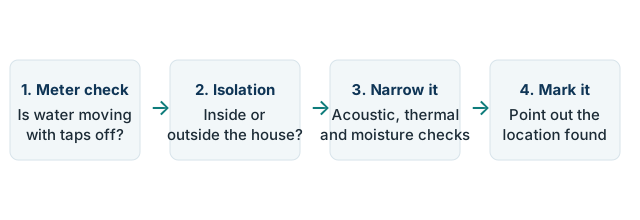
- Meter test. A moving meter with everything off confirms a supply leak is still present, somewhere.
- Ask for a system view. Ask the inspection to consider the system — material, pressure, and history — not just the new spot.
- Keep one file. Every leak, every repair, every report, in one place. That file is what turns separate events into a visible pattern.
That file is also what a plumber needs to assess a system. A plumber who sees three leak reports, with materials and locations, can judge whether spot repairs are still sensible or whether a broader repiping discussion is due. A plumber who sees only the latest leak cannot — and neither can a homeowner who has not kept the records.
When spot repair stops making sense
Spot repair stops making sense when leaks keep appearing in the same material, when the same area keeps leaking after repair, or when the cost of repeated spot repairs approaches the cost of a broader fix. That threshold is a plumber's assessment, not a detection claim — detection marks points, it does not price repiping. But detection can provide the evidence for that assessment: a set of marked points, with materials and locations, that show a pattern rather than a coincidence.
What detection should not do is keep marking new points without ever asking about the pattern. If you have had two or more leaks, say so on the call, and ask for the system view explicitly. A good inspection will welcome that question, because it makes the narrowing more accurate, not less.
Recurring leaks in Duluth, GA
For a Duluth home with recurring leaks, the practical sequence is: keep one file, meter-test each new sign, ask for a system view, and let a plumber judge the repiping question on the evidence. The service pages that cover the locations are slab, wall, and water line leak detection — and the pipe-material guide is pipe materials in Duluth homes.
How to talk to a plumber about a pattern
Talking to a plumber about a pattern is different from talking about a single leak, and it helps to prepare differently. Bring the file: every leak, every repair, every report, with locations, materials, and dates. Bring the timeline: when each leak appeared, what was repaired, and whether it returned. Bring the questions: is this material failing across the system, is pressure a factor, and at what point does a broader fix make more sense than another spot repair? A plumber who receives that preparation can give a system answer; a plumber who receives only “it is leaking again” can only give a spot answer.
Ask, too, about pressure. High water pressure stresses joints across a system, and it is a common contributor to repeated joint leaks that is easy to check and, where needed, easy to address. Pressure is not claimed here as the cause of any particular leak — it is a question to ask, and a check to have done, when leaks repeat at joints. If pressure is high, addressing it can reduce future leaks even before any repiping discussion, and that is worth knowing before another spot repair is booked.
Finally, be clear about what you want from the conversation. If you want a spot repair, say so, and the plumber will repair the spot. If you want a system assessment, say that explicitly, and expect a different visit: longer, more diagnostic, and priced differently. Both are legitimate requests, but they are not the same visit, and conflating them is how a pattern keeps being treated as a series of coincidences.
Keeping one leak file: what goes in it
One leak file, kept in a single place, is the practical tool that turns recurring leaks from a frustration into a pattern. What goes in it: every detection report, with marked points and ruled-out lists; every repair invoice, with dates, locations, and materials; water bills, with spikes noted and dated; meter readings, with dates; and photographs, with dates, of every stain, patch, and wet area. That file does not need to be elaborate — a folder, physical or digital, with documents in date order, is enough. What matters is completeness and dates, not presentation.
That file pays for itself in three ways. First, it makes each new inspection faster, because the inspector starts with history rather than from scratch. Second, it makes a system assessment possible, because a plumber can see the pattern across leaks rather than only the latest one. Third, it supports any later discussion — with an insurer, with a buyer, with a seller — because it shows when problems were noticed, what was done, and what the results were. A leak file is not bureaucracy; it is the record that turns separate events into evidence, and evidence is what decisions are made on.
One final note on patterns: a pattern is only visible if it is recorded. Homeowners who rely on memory will remember the worst leak and forget the smaller ones, and a pattern built on memory alone will be incomplete. The file — reports, invoices, bills, readings, photographs, all dated — is what makes a pattern reliable, and reliability is what makes it actionable. Start the file with the next leak, or reconstruct it from past paperwork if you can, and keep it going. It is the single most useful thing a homeowner with recurring leaks can do, and it costs nothing but organisation.
Common questions
Is a second leak just bad luck?
Usually not. A second leak in the same property points to a pattern: a material failing across the system, pressure stressing joints, or a source that was never found in the first place. Treating each leak as separate misses the pattern, and the pattern is what needs addressing.
What if a leak returns in the same place after repair?
Then the first repair probably addressed a symptom, not the source — a stain was patched or a section replaced, but the leaking pipe was never narrowed. Re-narrow from the meter, rather than from the last repair, to break that cycle.
When should I consider repiping instead of spot repairs?
When leaks keep appearing in the same material, when the same area keeps leaking after repair, or when repeated spot repairs approach the cost of a broader fix. That threshold is a plumber's assessment on the evidence of marked points, not a detection claim.
What records should I keep about leaks?
Every leak, every repair, and every report, in one file: locations, materials, dates, meter results, and marked points. That file is what turns separate events into a visible pattern, and it is what a plumber needs to assess a system.
Can detection find a system problem, or only a leak point?
Detection marks points, but a set of marked points with materials and locations is evidence about a system. Say on the call that you have had multiple leaks and ask for a system view — the inspection will consider material, pressure, and history, not just the new spot.