 Duluth Water Leak Detection Pros
Slab Leak Detection in Duluth, GA
Slab leak detection in Duluth, GA, in ZIP codes 30096 and 30097, finds a pipe leak under a concrete floor without opening it first. We check your meter, narrow the area with acoustic and thermal checks, and mark the leak point for repair.
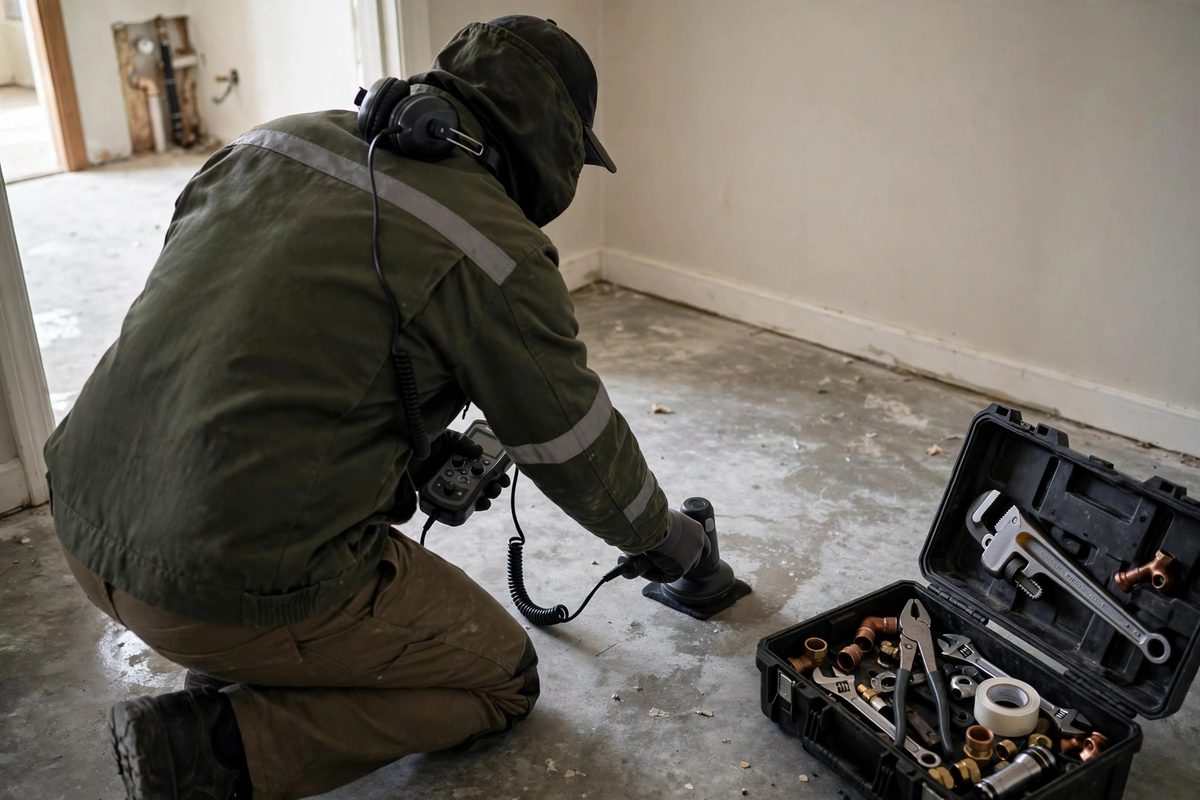
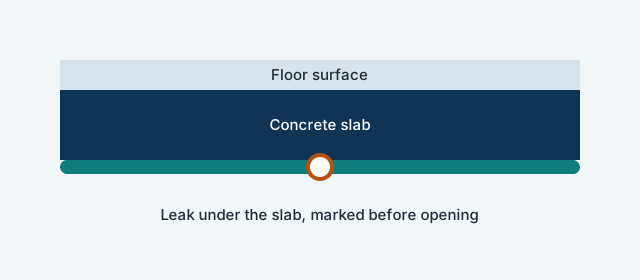
A slab leak is a leak in a pipe that runs beneath a concrete slab floor. You cannot see the pipe, and you usually cannot see the leak itself. What you see are the effects: heat or dampness reaching the floor surface, a bill that climbs, or flooring that changes. That is why slab detection is a different job from fixing a visible drip. The work is not to look harder at the floor, but to narrow the pipe underneath it to a point that can be marked and discussed before anything is cut.
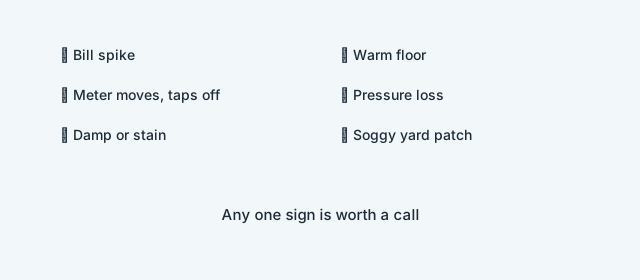
Signs of a slab leak
Not every sign below appears on every slab leak, and some signs overlap with other leaks. The pattern matters more than any single item. A bill spike plus a warm floor is a stronger slab signal than a bill spike alone, which could also be a toilet, an appliance, or a yard line.
| Sign | What it suggests |
|---|---|
| Warm patch on a tile or concrete floor | A hot-water line leaking under the slab, warming the concrete above it |
| Water bill rises with no change in use | Water escaping continuously under pressure, often before any visible dampness |
| Damp flooring, warped boards, or lifting tiles | Moisture reaching the floor surface from below over time |
| Sound of running water under the floor | Pressurised water escaping from a concealed pipe |
| Damp baseboards or a musty smell near a floor | Moisture travelling from the slab into wall and floor materials |
| Meter moves with everything off | A leak somewhere in the system — the shutoff test then separates slab from yard |
Warm floors, damp flooring, and water sounds: slab leak signs in Duluth, GA
A warm patch on a floor, damp or warped flooring, and the sound of running water with everything off are the signs most often linked to a slab leak. A bill that rises with no change in use, and a meter that moves with every tap off, support the same suspicion. None of those signs alone proves a slab leak, which is why the meter test and isolation come before any slab conclusion is drawn.
Who needs slab leak detection
This page is for a homeowner or property manager in Duluth who has a slab floor and one of the signs above, especially a warm floor or a bill spike that a toilet check has not explained. It is also for someone who has already had a visible-leak check that found nothing, because a slab leak is exactly the kind of leak a visual check cannot find. If the leak is visible — a dripping tap, a pipe joint you can see — a general plumber is the faster first call, because the source is already known and the job is repair, not search.
Slab detection is also the right step before any concrete work is authorised. Cutting a slab to search for a leak is expensive and disruptive, and it often opens the wrong spot when the search is guided by a stain rather than a narrowed location. A detection inspection that marks a point first lets any later repair be discussed with a location in hand, including what it would open and what it would cost, before work starts.
How slab leak detection works
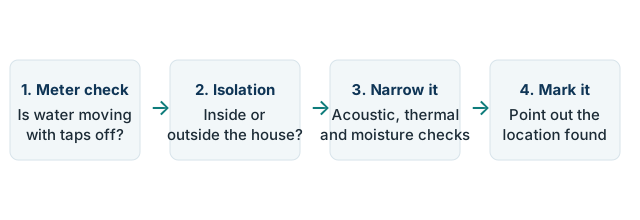
The inspection follows the same narrowing logic as other detection work, with the checks chosen for a pipe under concrete. It starts with a conversation about symptoms — when the bill changed, where the floor feels warm or damp, and what has already been checked — because those details decide which checks are useful and which would waste time.
- Meter check. With every tap, appliance, and toilet cistern off, the meter is read, then read again after a period without water use. Movement confirms water is escaping somewhere in the system.
- Isolation. The house shutoff is closed. If the meter stops, the leak is inside, which keeps a slab leak in play. If it keeps moving, the leak is more likely on the buried yard line, and the underground page answers that question instead.
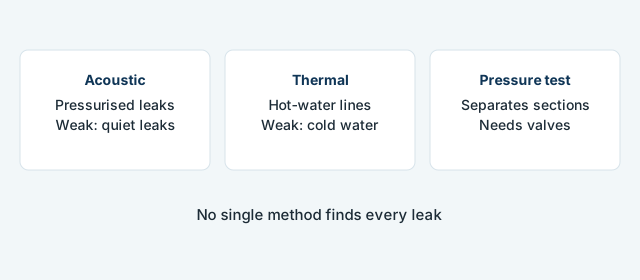
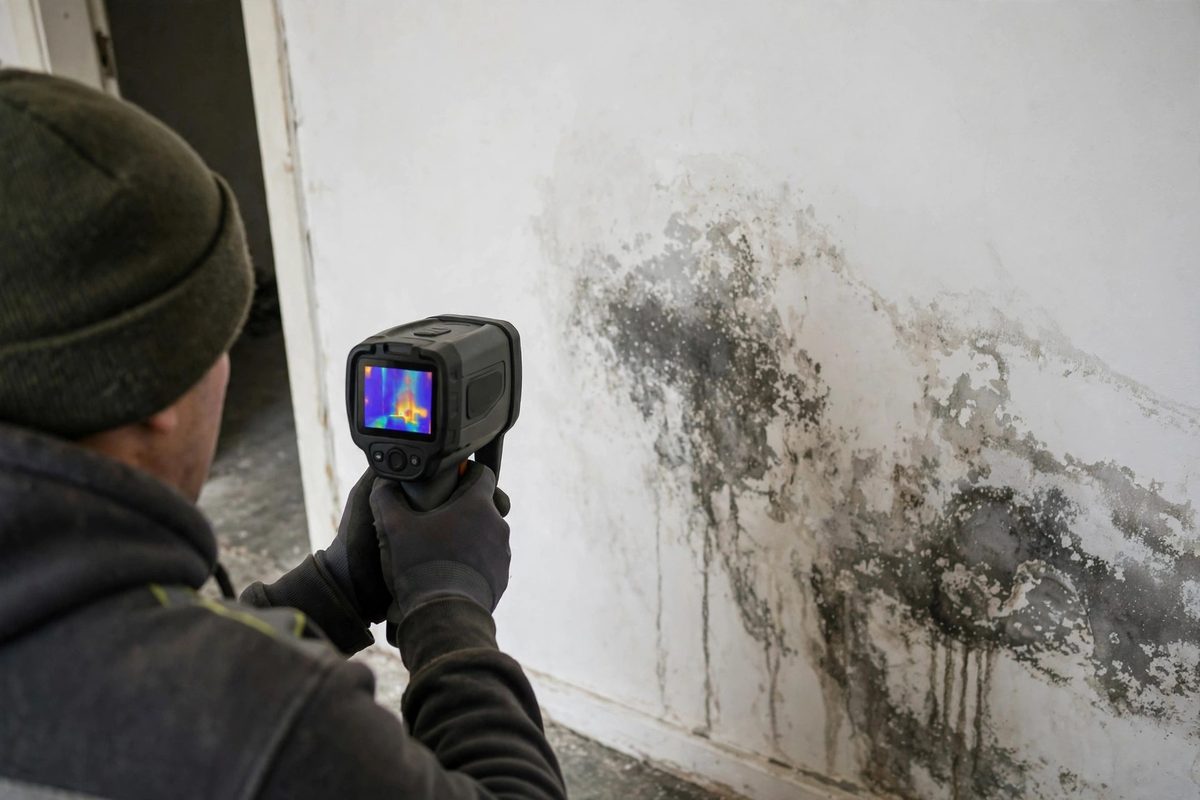
- Thermal narrowing. A thermal camera looks for temperature patterns on the floor surface. This works best for hot-water lines, where escaping water warms the slab. It is weaker for cold-water leaks, where the temperature difference is small.
- Acoustic narrowing. Listening equipment picks up the sound of pressurised water escaping. Depth, floor covering, and background noise all affect how clear that signal is, so it is used alongside the thermal pattern, not as a single proof.
- Mark and explain. The narrowed point is marked and explained, including how confident the narrowing is and what the next step — repair, rerouting, or a further check — would involve.

Slab leak detection in Duluth, GA, step by step: meter, isolation, thermal, acoustic
The sequence is meter first, then isolation, then narrowing. The meter test confirms flow, isolation separates inside from outside, thermal imaging looks for temperature differences where hot water is involved, and acoustic listening listens for pressurised water escaping. Each method has limits: thermal is weaker on cold water and does not see through walls, and acoustic is weaker on quiet leaks. A location several checks agree on is more reliable than a location from one check alone.
Methods used for slab leaks, and their limits
Competitor pages in the Duluth and Atlanta area often present one method as the answer. The honest version is that slab detection combines methods, and each one has a limit that matters for a concrete floor. Thermal imaging does not see through concrete; it reads surface temperature, so thick coverings and cold-water leaks weaken it. Acoustic listening hears pressurised water, but a slow leak may be quiet and a busy house may mask it. Moisture readings show where damp has reached, not necessarily where the pipe broke, because water travels along a slab before it surfaces. Pressure testing can separate sections of pipe, but it needs access points that may not exist in every home.
That combination is also why the page does not list a specific brand of equipment as the provider's. The methods above are the standard methods used in slab detection, described here so a caller can ask good questions. Which methods are used on a particular job depend on the symptoms, the floor, and the pipe layout, and are confirmed on the call. A provider who promises a location from a single check, sight unseen, is promising more than these methods can deliver.
Detection versus opening to search
| Approach | Opening | Result |
|---|---|---|
| Detection first | Marked point only | Location known before work |
| Opening to search | Multiple exploratory cuts | Often the wrong spot |
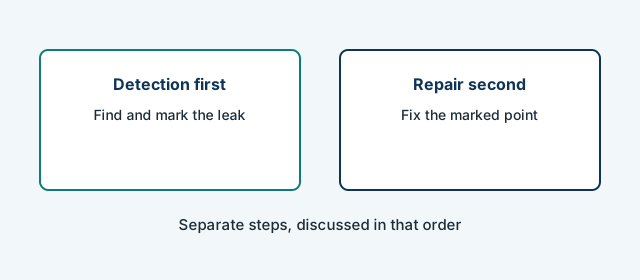
What slab detection does and does not do
We locate the leak and explain how we narrowed it. It does not repair the pipe, reroute a line, or replace a section — those are separate decisions, discussed after the location is known. It does not guarantee that a leak will be found on the first visit, because some leaks are slow, deep, or masked by floor coverings. It does not cover gas, roof, or pool leaks, and it does not replace a general plumber for a visible leak. What it does give is a marked location and a clear next step, instead of a search that opens concrete to find out where to look.
What affects the cost of a slab leak inspection
We do not publish a fixed price here, because no price has been supplied for our business and national ranges found online are not Duluth prices. The factors that move the fee for a slab job are specific: the floor covering and its thickness, which affect thermal and acoustic signals; whether the leak is hot or cold water, which decides which checks are useful; the size of the slab area that has to be ruled out; how many pipe sections can be isolated for pressure testing; and whether the inspection has to work around finished flooring that cannot be disturbed. Detection and any later repair are priced separately, so ask on the call whether the detection fee is separate from a repair quote, and what the inspection includes — a marked location and an explanation, not a repair.
Safety and limits for slab leaks
If water is spreading across a floor, a ceiling below is sagging, or you hear a steady rush under the floor, shut off the main water valve if it is safe to reach, keep clear of wet electrical outlets and switches, and call. Do not touch wet electrics. A slab leak that has been running for a while may have damaged flooring and baseboards, and the repair discussion should include what else has been affected, not just the pipe. If you smell gas, leave and call your gas utility or emergency services — that is not a slab-leak job.
Who carries out slab leak detection in Duluth, GA
Slab leak detection inspections are carried out by licensed and insured technicians. The business holds Georgia Master and Journeyman Plumber Licences, and its technicians include a Certified Leak Detection Specialist. The full list of licences and certifications is on the About page. Licence numbers are not published on this site — ask on the call if you need a number for your records.
Common questions about slab leaks in Duluth
What is a slab leak?
A slab leak is a leak in a water pipe that runs under a concrete floor slab. The pipe itself is hidden, so the leak is usually noticed by its effects first: a warm patch on the floor, a water bill that rises for no clear reason, damp flooring, or the sound of water under the floor. Because the slab covers the pipe, finding the leak takes a narrowing inspection rather than a visual check.
Why is a warm patch on the floor a slab-leak sign?
A warm patch points to a hot-water line leaking under the slab, because the escaping hot water warms the concrete and the floor above it. Cold-water leaks do not warm the floor in the same way, so a cold-water slab leak may show only as a bill spike or dampness. That is why a warm floor is a useful clue but not a complete test on its own.
Does finding a slab leak mean the concrete has to be broken?
Not always, and not before the location is known. Detection narrows the leak to a marked point first, using the meter test, isolation, and thermal and acoustic checks. Any opening that follows is discussed after that point is marked, and the size and position of the opening depend on the leak and the repair method chosen. Detection itself does not repair the pipe.
How is a slab leak different from a yard leak?
A slab leak is inside the house, under the floor. A yard leak is on the buried line outside, between the meter and the house. The house-shutoff test separates them: close the shutoff and a slab leak is on the inside side, while a yard leak keeps the meter moving. Getting this distinction right matters, because the checks and the access are completely different.
What should I do if I suspect a slab leak?
Start with the meter test: turn everything off, note the reading, wait without using water, and read it again. Movement points to a leak. Note the symptoms too — where the floor feels warm, where flooring looks damp, and when the bill changed. Those three facts help the call go faster and help the inspector know which checks to start with.
Can a slab leak damage the house if it is left alone?
Yes, over time. Water under a slab can keep a floor damp, damage flooring and baseboards, and encourage mould growth in damp materials. It also wastes water continuously, which is why the bill is often the first sign. How fast damage appears depends on the leak rate and the materials involved, so a suspected slab leak is worth a call rather than a wait-and-see approach.
Are slab leaks common?
A slab leak is a leak in a pipe beneath a concrete floor slab, so it is a leak type that affects homes built on a slab rather than homes with raised floors or basement pipes. It is usually noticed by its effects first: a warm patch, a rising bill, damp flooring, or the sound of water under the floor. Any of those signs is a reason to check, rather than waiting to see if they pass.
Will a slab leak show on the water meter?
A slab leak on a supply pipe usually will: with every tap off, the meter keeps moving, because water is still leaving the system under the slab. A leak on a drain line under the slab may not move the meter at all, because drain water is not metered as supply. That is why the meter test is a first check, not a final answer, and it is followed by isolation and method checks that narrow the point.
How does slab leak detection work?
It starts with the meter test, then the house shutoff test to separate an inside leak from a buried yard leak. After that, acoustic listening, thermal imaging for hot-water lines, and moisture checks are used together to narrow the area, and the agreed point is marked before any opening. No single method is trusted alone, and a result the checks do not agree on is stated as inconclusive.
Call (770) 214-4798
Inside or outside? How slab leak detection in Duluth, GA rules out a yard leak
Before a slab conclusion is drawn, the house shutoff test rules out a yard leak. With the house shutoff closed, a meter that stops points inside the house, including under the floor. A meter that keeps moving points to a buried line outside. That distinction matters, because opening a floor to search for a yard leak would be the wrong job, and digging a yard to search for a slab leak would be the wrong job too.
After marking: what a slab leak detection result in Duluth, GA tells you next
A slab result is a marked point and an explanation, not a repair offer. It tells you where the checks agreed, which methods supported that point, and what repair discussion should follow at that point. Detection does not include repair, and no repair scope is assumed before the location is known. If you need repair, that conversation starts from the marked point, not from a fresh search.
When slab leak detection in Duluth, GA is inconclusive
Sometimes the checks do not agree, or no check confirms a location under the floor. In that case the result is stated as inconclusive, not guessed, and no concrete is opened on a guess. The report will explain which checks agreed, which did not, and what further checks would be needed. An inconclusive result is not a failed visit: it prevents an opening in the wrong place.