 Duluth Water Leak Detection Pros
Water Line Leak Detection in Duluth, GA
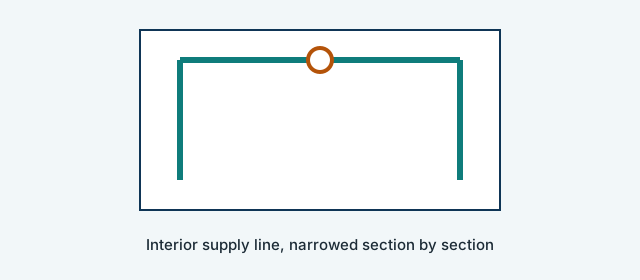
Water line leak detection in Duluth, GA, in ZIP codes 30096 and 30097, finds a leak in an interior supply pipe. We test sections of pipe one at a time with pressure and acoustic checks, narrow the section that loses pressure, and mark the leak point.
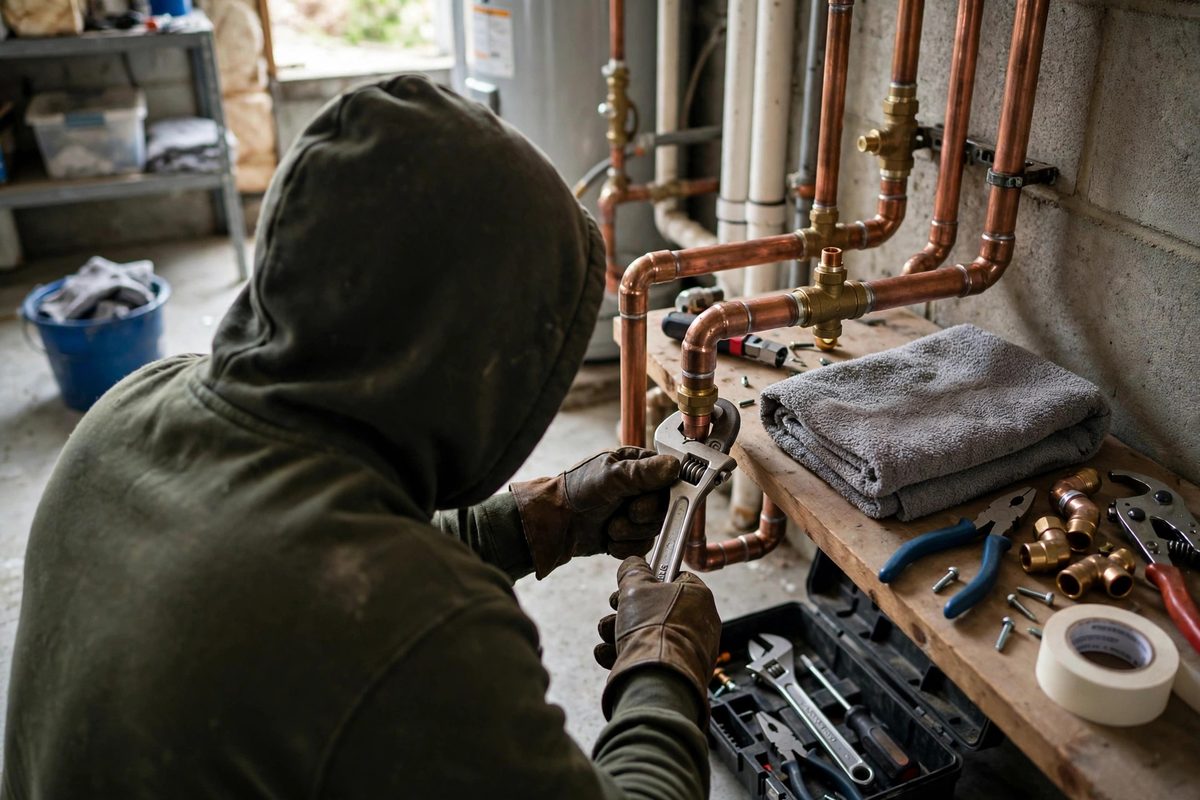
A water line is an interior supply pipe. It carries pressurised water from the house entry to every tap, toilet, and appliance. When one of those pipes leaks inside a wall, under a floor, or inside a cabinet, the water does not always appear where the pipe broke. It travels along the pipe, soaks into materials, and surfaces somewhere else. That travel is the reason a water-line leak is hard to find by looking, and the reason detection narrows the line section by section instead of opening the wall where the dampness shows.
Signs of a water line leak
The pattern to watch is a system-wide change, not a single fixture. Pressure that drops across several fittings, a meter that moves with everything off, and a bill that climbs all point to a supply line. A single dripping tap or a single slow toilet points to a fixture, and that is a different job.
| Sign | What it suggests |
|---|---|
| Pressure drops across several fittings | A supply line losing water before it reaches the fixtures |
| Meter moves with everything off, stops with shutoff closed | An interior leak, on a supply line rather than the yard line |
| Damp cabinet, floor, or wall near a pipe run | Water travelling from a concealed supply pipe to a surface |
| Musty smell in one area, no visible source | Moisture held in wall or floor materials from a slow leak |
| Sound of running water with taps off | Pressurised water escaping from a concealed supply pipe |
| Hot-water supply runs out faster than usual | A hot-water supply line leaking, losing heated water continuously |
Low water pressure in only part of the house: water line leak detection in Duluth, GA
Pressure that drops in only part of a house, while other taps stay normal, points toward a line serving that part, rather than a whole-property supply problem. It is a sign to combine with the meter test and the bill history, not a diagnosis on its own. If the meter moves with everything off and pressure is low in one section, that section is where narrowing starts.
Who needs water line leak detection
This page is for a Duluth homeowner or property manager with a system-wide sign — pressure loss, a moving meter, a bill spike — and no visible source. It is also for someone who has had a fixture checked and found nothing, because a supply-line leak is the next explanation when fixtures are ruled out. If the leak is visible, or if only one fixture is affected, a general plumber is the faster first call, because the source is already known or localised. Detection earns its fee when the source is hidden and the alternative is opening walls to search.
Water-line detection is also useful before a remodel or a floor replacement. A slow supply leak that has soaked a wall or floor for months will damage new work if it is not found first. An inspection that narrows the line before new materials go in is cheaper than opening finished work later to find a leak that was there all along.

How water line leak detection works
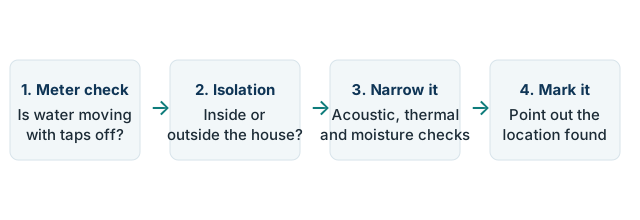
The inspection is a process of elimination. Each step rules out a section of pipe, so the area that remains gets smaller until a point can be marked.
- Meter and isolation. Everything off, meter read, then read again. Then the house shutoff is closed: if the meter stops, the leak is inside, and this page is the right page.
- Fixture and appliance check. Toilets, taps, and appliances are ruled out first, because a running toilet or a faulty appliance can move a meter and mimic a pipe leak. A dye test can help with a silent toilet leak.
- Section isolation. Where valves allow, sections of supply pipe are isolated and pressure-tested. A section that loses pressure contains the leak; a section that holds does not. This is the step that turns a whole-house problem into a room or a wall.
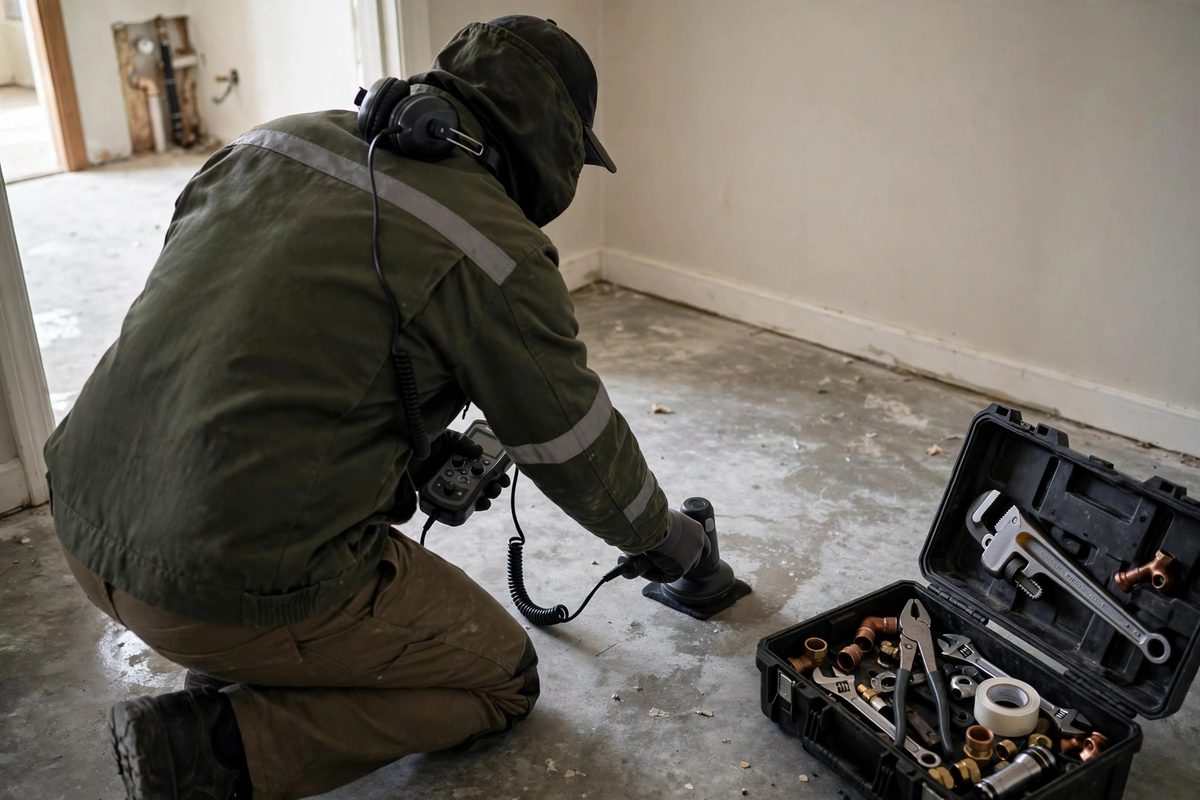
- Acoustic and moisture narrowing. Within the suspect section, listening and moisture readings narrow the point. Thermal imaging helps on hot-water lines and is weaker on cold-water lines, so it is used where it fits, not on every job.
- Mark and explain. The narrowed point is marked, with the pipe material and the repair options discussed after the location is known. Detection does not repair the line.
Methods for interior supply lines, and their limits
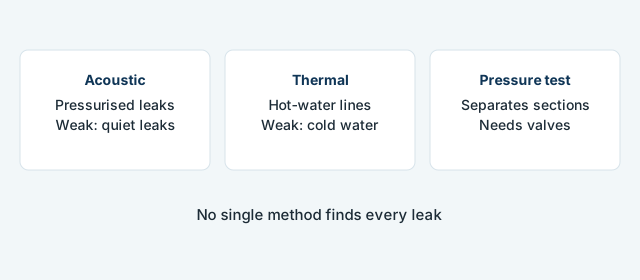
Interior lines offer more access than a slab or a yard line, which is both an advantage and a trap: more access means more sections to test, and a careless inspection can spend time on sections that the meter test had already ruled out. Pressure testing is the most decisive method here, because it separates sections cleanly, but it needs valves that exist and work. Acoustic listening is useful in a quiet house and less useful with background noise or thick wall coverings. Moisture readings show where water has reached, not where it broke, because water travels along a pipe before it surfaces. Thermal imaging shows temperature patterns, so it helps on hot-water lines and is weak on cold-water lines.
Pipe material also changes the inspection. Copper, PEX, PVC, galvanised, and polybutylene pipes leak in different places and are repaired differently, and the material affects which checks are most useful. This page does not claim the provider works with every material; the material in your home is a question to ask on the call, so the inspection can be planned for the pipes that are actually there.

Hot versus cold: section-by-section isolation for water line leak detection in Duluth, GA
Isolation for a water line leak is section by section: hot versus cold, house versus yard, and supply versus irrigation where that distinction fits. Closing a section and rechecking the meter tells us whether that section is the source. A valve that does not close fully makes the test inconclusive, and that is stated plainly rather than treated as a clear result. Section isolation is what turns a general supply suspicion into a narrowed line to check.
Water line versus wall, slab, and underground — the overlap, stated once
Callers often arrive unsure which page fits, and the overlap is real. A water line leak can show as a wall leak, because the water surfaces on a wall. It can show as a slab leak's symptoms, because a supply line can run under a floor. And it can be confused with a yard leak, because both move a meter. The shutoff test is the first separator: inside versus outside. Within the inside, the second separator is the surface that shows the water: a floor points to slab, a wall points to the wall page's diagnostic work, and a system-wide pressure loss with no surface sign points to this page. The inspection itself does not care which page you started from — it follows the same narrowing logic and ends at the pipe that is actually leaking.
Which service fits which sign
| Service | Main sign | Key test |
|---|---|---|
| Slab | Warm floor | Thermal + acoustic |
| Underground | Wet yard | Shutoff closed, meter moves |
| Water line | Pressure loss | Section pressure test |
| Wall | Damp wall | Meter + source separation |
What affects the cost of a water line inspection
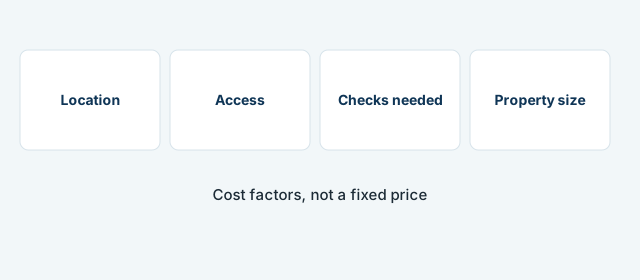
No fixed price is published here, because no price has been supplied and national ranges are not Duluth prices. For an interior line, the fee moves with how many sections have to be isolated, whether working valves exist for those sections, how many floors and bathrooms the line serves, whether the leak is on a hot or cold line, and how much finished wall or floor has to be worked around. Detection and repair are priced separately. Ask on the call what the inspection includes, whether pressure testing is part of it, and what a repair would open, before any wall is opened.
Safety and limits for water line leaks
If water is spreading inside a wall or across a floor, shut off the main valve if it is safe to reach, keep clear of wet electrical outlets and switches, and call. Do not open a wall yourself to look for a pipe — you may cut into a live wire or a drain line, and you will not narrow the leak by looking. If the leak is visible and you can reach a local valve, that valve plus a general plumber is the faster route. If you smell gas, leave and call your gas utility or emergency services.
Who carries out water line leak detection in Duluth, GA
Water line leak detection inspections are carried out by licensed and insured technicians. The business holds Georgia Master and Journeyman Plumber Licences, and its technicians include a Certified Leak Detection Specialist. The full list of licences and certifications is on the About page. Licence numbers are not published on this site — ask on the call if you need a number for your records.
Common questions about water line leaks in Duluth
What is a water line leak?
A water line leak is a leak on an interior supply pipe — the pipes that carry water from the house entry to taps, toilets, and appliances. It is different from a slab leak, which is under a concrete floor, and from an underground leak, which is on the buried line outside. The house-shutoff test separates them: if the meter stops when the shutoff is closed, the leak is on an interior line.
Why does my water pressure drop when a line leaks?
A leak lets water escape before it reaches a fixture, so less pressure arrives at the taps. When the drop affects several fittings at once, rather than one tap, it points to a supply line rather than a single fixture. A drop at one tap only is more likely a fixture or a local connection, and a general plumber is the faster first call for that.
Can a water line leak hide behind a wall or under a sink?
Yes. Supply lines run behind walls, under floors, and inside cabinets, so a leak can soak materials for weeks before it shows. The first signs are often a bill spike, a meter that moves, dampness in a cabinet, or a musty smell in one area. The leak's location is found by narrowing the line section by section, not by opening every wall along its path.
Does pipe material matter for a water line leak?
Yes, for both the leak's likely cause and the repair that follows. Copper, PEX, PVC, and older materials such as galvanised or polybutylene behave differently, and the repair method depends on the material. The material in your home is a useful fact to have on the call, if you know it from a previous plumbing visit, but it is not required to arrange an inspection.
How is a water line leak different from a wall leak?
The two overlap, and this page and the wall page are the pair where callers most often need help choosing. A water line leak is defined by the pipe that is leaking. A wall leak is defined by where the water shows — behind or on a wall. A wall leak may be a water line leak, a drain issue, or condensation. The inspection first separates those causes, then narrows the pipe if the cause is a supply line.
What should I do if a supply line is leaking visibly?
If you can see the pipe and the water, turn off the local valve for that fixture or the main valve if there is no local valve, and call a general plumber for repair, because the source is already known. Detection is for when the source is hidden. If the visible leak is inside a wall cavity and you cannot reach a valve safely, shut off the main valve and call.
How do I detect a water line leak?
Start with the meter test: turn every tap off, read the meter, wait, and read it again. If it moves, close the house shutoff: if it stops, the leak is inside; if it keeps moving, it is likely buried. Visible joints, valves, and appliance connections are checked first, because a leak you can see needs a plumber, not a search. A hidden line is then narrowed by isolation and acoustic or pressure checks before any opening.
Call (770) 214-4798
Reading your water bill before water line leak detection in Duluth, GA
Before a water line check, compare your bill history, not just the latest total. Look at volume as well as charge, the days covered, and whether the reading was estimated or actual. Changes in occupancy, irrigation schedules, and appliance use can explain a higher bill without a pipe leak. Measuring the loss yourself, by comparing bills and running the meter test, gives the inspection a starting point and prevents a buried-leak assumption from a single high bill.
Water line leak detection in Duluth, GA with no visible water
A water line leak can hide behind a wall or under a sink with no visible water at all. The signs are indirect: a bill that rises, a meter that moves with everything off, a sound of running water with nothing on, or pressure that drops in one part of the house. In that case detection starts with the meter test and section isolation, not with opening a wall to look. Opening comes only after the checks agree on a marked point.
What to do while waiting for water line leak detection in Duluth, GA
If water is showing, shut off the main valve if it is safe to reach, move items away from the water, and do not open a wall or floor to search. If no water is showing, run the meter test with everything off and note the result, including whether the house shutoff changed it. Call with your ZIP code, your symptoms, and that meter result. No arrival time is promised on this page, because none is supplied for this business.