 Duluth Water Leak Detection Pros
Ceiling Leak Detection in Duluth, GA
Ceiling leak detection in Duluth, GA, in ZIP codes 30096 and 30097, finds the plumbing source above a stained or sagging ceiling without opening it first. We check the meter, rule out roof and condensation sources, narrow the pipe with acoustic and thermal checks, then mark the point to open.
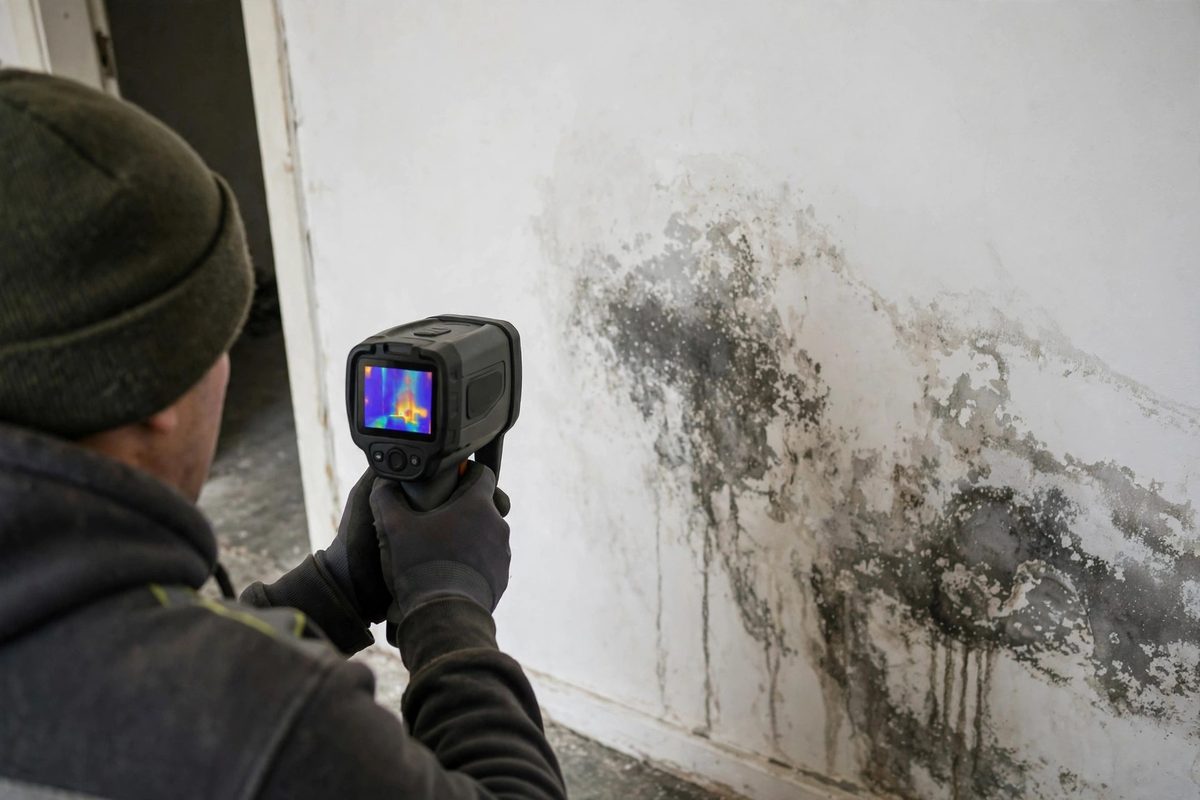
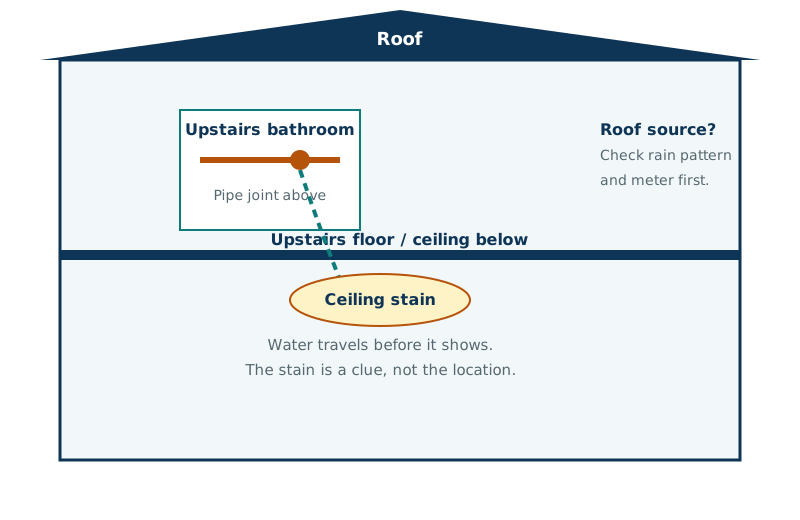
A ceiling leak is defined by where the water shows, not by what is leaking. That definition matters, because a stained ceiling is a symptom with several possible causes, and only some of them are plumbing. A pipe joint in the floor above, an upstairs bathroom connection, a roof leak, and condensation in the ceiling space can all produce a stain that looks the same from below. This page is therefore a diagnostic page first and a locating page second: its job is to separate a plumbing leak from a roof or condensation source, and only then to narrow a pipe if the cause is plumbing.
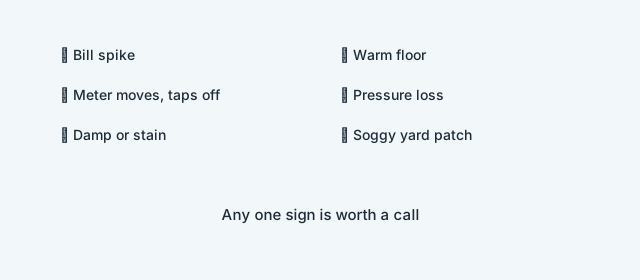
Signs of a ceiling leak
Ceiling signs develop in stages, which is why they are often noticed late. A faint yellow or brown mark appears, paint bubbles, a small bulge forms, and only later does the ceiling sag or drip. By that time water may have travelled some distance along joists or inside the ceiling space, so the stain's position is a starting point, not a diagnosis. A stain that grows after rain only, a stain that grows regardless of weather, and a stain that appears after a shower upstairs are three different stories, and the inspection treats them as such.
| Sign | What it suggests |
|---|---|
| Yellow or brown stain, growing slowly | Water reaching a ceiling surface from above, over time |
| Paint bubbling or peeling on a ceiling | Moisture held in ceiling materials, often from a slow leak |
| Sagging or bulging ceiling section | Water collecting above the ceiling — stay out from under it and call |
| Stain that grows after rain only | A roof or exterior source, not necessarily a supply pipe — check before assuming plumbing |
| Stain that grows regardless of weather | A supply or drain leak, because it does not depend on rain |
| Stain that appears after an upstairs shower or bath | An upstairs fixture or connection — check the floor above first |
| Meter moves with everything off | A supply leak somewhere — the ceiling is one candidate, not the only one |
Who needs ceiling leak detection
This page is for a Duluth homeowner or property manager with a stained, bubbling, or sagging ceiling and no visible source. It is also for someone who has had a ceiling painted or patched and watched the stain return, because a returning stain usually means the source was never found. If the water is visible and the pipe is accessible — a connection under a sink, a visible joint — a general plumber is the faster first call. Ceiling detection is for when the source is concealed above the ceiling and the alternative is opening a ceiling to search.
Ceiling detection is also the right step when the cause is genuinely uncertain. A caller who is not sure whether a ceiling stain is plumbing, roof, or condensation should not have to choose a trade before an inspection. The diagnostic work on this page is designed to answer that question first, even when the answer is that the cause is not plumbing at all.
How ceiling leak detection works
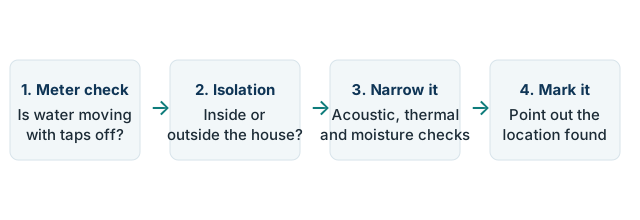
The inspection is a separation first, then a narrowing. Skipping the separation is the most common mistake in ceiling work, because it leads to opening a ceiling for a leak that is actually coming from the roof or from condensation.
- Meter check. Everything off, meter read, then read again. Movement points to a supply leak; no movement points away from supply and toward a drain, a roof source, or condensation.
- Source separation. The floor above is checked — upstairs bathroom fixtures, connections, and any visible pipework — and the pattern is compared with weather: rain-only growth points away from supply.
- Section narrowing. If the cause is a supply pipe, sections are isolated where valves allow, and acoustic and moisture readings narrow the ceiling section. The stain is treated as a clue, not as the location.
- Mark and explain. The narrowed point is marked, with an explanation of what was ruled out as well as what was found. If the cause is not plumbing, that is stated plainly, with the next trade to consider.

Methods for ceiling leaks, and their limits
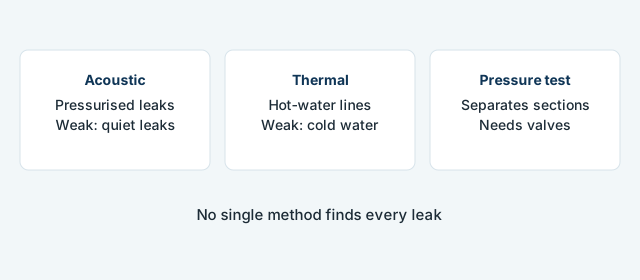
Ceiling work relies on a combination that is easy to overstate. Moisture readings show where damp has reached, not where the pipe broke, because water travels along joists before it surfaces. Acoustic listening can pick up a pressurised leak above a ceiling, but ceiling materials, insulation, and background noise affect it. Thermal imaging can show a damp or warm pattern on a ceiling surface, but it does not see through a ceiling, and a cold-water leak may show little temperature difference. Pressure testing can confirm a section, but it needs valves that may not exist for a particular ceiling run.
The honest summary is that no ceiling method gives a location on its own. The location comes from the combination, plus the meter and separation work that came before it. A provider who marks a ceiling from a single thermal image, without a meter test, is marking a pattern, not a leak.

Plumbing leak, roof leak, or condensation — the ceiling three-way split
These three causes are the ceiling diagnostic, and they are worth stating in full. A supply leak moves the meter, grows regardless of weather, and is found by section narrowing. A roof leak grows after rain, usually does not move the meter, and belongs to a roofing trade. Condensation forms in ceiling spaces in humid conditions, does not move the meter, and is usually linked to ventilation rather than to a pipe. The inspection checks all three before it marks a point, and the page's FAQs return to this split because it is the question callers most often need answered before they authorise any opening.
| Cause | Meter | When it grows | Next step |
|---|---|---|---|
| Supply leak (upstairs pipe) | Moves | Any weather | Narrow the pipe |
| Roof leak | Usually still | After rain | Roofing trade |
| Condensation | Still | Humid conditions | Ventilation check |
| Drain leak upstairs | Still (drains are not pressurised) | After upstairs use | Drain specialist |
What affects the cost of a ceiling leak inspection
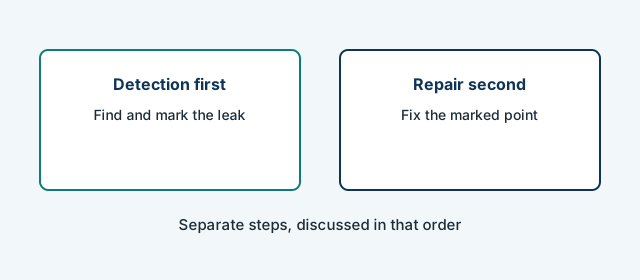
No fixed price is published here, because no price has been supplied and national ranges are not Duluth prices. For a ceiling job, the fee moves with how much separation work is needed — whether a roof source has to be ruled out, how many upstairs fixtures and connections have to be checked, whether section valves exist, how much finished ceiling has to be worked around, and whether the dampness has spread to more than one ceiling section. Detection and any later opening or repair are priced separately. Ask on the call what the inspection includes, what it will rule out as well as find, and what an opening would involve, before any ceiling is cut.
What a ceiling inspection result should tell you
A useful ceiling result is not just a mark on a ceiling. It should tell you, in plain terms, what was ruled out and what was found: whether the meter moved, whether the floor above was checked, which upstairs fixtures were ruled out, which ceiling section was narrowed, and how confident that narrowing is. It should also tell you what happens next if the cause is not plumbing — for example, whether the next step is a roofing trade, a ventilation or condensation check, or a drain specialist — rather than leaving you with a stained ceiling and no direction. If an inspection gives you a mark but cannot explain the meter result or the separation work behind it, ask for that explanation before any opening is authorised.
When to call a different trade is part of the same result. A stain that grows only after rain, with a meter that does not move, points away from supply plumbing and toward a roof or exterior source. A ceiling stain with no meter movement and no upstairs source points toward condensation or ventilation. A ceiling leak that is actually a drain leak will not move the meter either, because drains are not pressurised, and it needs a drain specialist rather than a supply-line repair. Naming the right next trade, even when it is not this service, is part of an honest ceiling inspection, not a failure of it.
Safety and limits for ceiling leaks
If a ceiling is sagging, stay out from under it: it can hold more water than it appears to, and it can come down without warning. If water is spreading, shut off the main valve if it is safe to reach, keep clear of wet electrical outlets, switches, and light fittings, and call. Do not poke or cut into a ceiling yourself: ceilings contain wiring and other services, and an unguided opening creates a larger repair without narrowing the leak. If the dampness is accompanied by a gas smell, leave and call your gas utility or emergency services. A ceiling that has been damp for a long time may have damaged materials above the surface, and the repair discussion should include those materials, not just the pipe.
Who carries out ceiling leak detection in Duluth, GA
Ceiling leak detection inspections are carried out by licensed and insured technicians. The business holds Georgia Master and Journeyman Plumber Licences, and its technicians include a Certified Leak Detection Specialist. The full list of licences and certifications is on the About page. Licence numbers are not published on this site — ask on the call if you need a number for your records.
Common questions about ceiling leaks in Duluth
What causes a ceiling stain if no pipe is visible?
A ceiling stain can be a supply pipe leaking in the floor above, a drain or fixture connection leaking upstairs, a roof leak, or condensation forming in the ceiling space. The inspection's first job is to separate those causes, because each one belongs to a different fix. Opening the ceiling before that separation risks opening the wrong spot for the wrong reason.
Is a ceiling leak always a plumbing leak?
No. A roof leak and condensation can both stain a ceiling without any pipe leaking. A supply leak usually moves the meter and grows regardless of weather, while a roof leak usually grows after rain and condensation usually does not move the meter at all. That is why the meter test is done before any ceiling is opened — it separates a plumbing question from a roof or moisture question.
How do you find a ceiling leak without opening the whole ceiling?
By narrowing first: meter check, then ruling out the floor above and any roof or condensation source, then acoustic and moisture readings within the suspect ceiling section. The stain itself is rarely the leak's exact position, because water travels along joists and surfaces before it shows. The marked point is where the narrowing points, not where the stain is largest.
Should I poke or open the ceiling myself to look?
No. A sagging or wet ceiling can hold more water than it appears to, and a ceiling contains wiring and other services. Poking it can release water suddenly and create a larger repair without finding the leak. If a ceiling is sagging, stay out from under it, shut off the main valve if water is spreading and it is safe to reach, keep clear of wet electrics, and call.
What happens if the ceiling leak turns out to be a roof leak?
Then the inspection has still done useful work: it has ruled out a supply leak and pointed to the roofing trade. That ruling-out is stated plainly rather than dressed up as a location, because a false location is worse than an honest referral. Roof work, like other trades, is not a service offered on this page.
Can a ceiling leak come from an upstairs bathroom?
Yes, and it is one of the first sources checked. A shower seal, a tub or toilet connection, or a pipe joint in the floor above can all send water down into the ceiling below. The inspection still narrows rather than assumes: the upstairs fixtures are checked, the meter is read, and only then is a point marked. Assuming the bathroom without checking is how the wrong ceiling section gets opened.
What happens if the checks do not agree?
Then the result is stated as inconclusive, and no ceiling is opened to search. A location several checks agree on is more reliable than any single reading, and a single thermal image or moisture reading on its own does not mark a point. An honest inconclusive result, with the next check named, is better than a confident mark that turns out to be wrong.
Call (770) 214-4798
Ceiling leak detection in Duluth, GA: one marked point, not exploratory openings
The goal of ceiling detection is one marked point, not exploratory openings. The inspection narrows with the meter test, isolation, acoustic listening, thermal imaging, and moisture readings, and opening is kept to the marked point, and only after the location is discussed with you. If the checks do not agree, the result is stated as inconclusive, and no ceiling is opened to search. That discipline is what non-invasive detection means in practice for a ceiling.
What a ceiling stain above a bathroom in Duluth, GA usually points to first
A stain directly below an upstairs bathroom is checked as a bathroom source first, but it is not assumed to be one. The shower seal, tub and toilet connections, and any pipe joint in that floor are checked in turn, and the meter result is read alongside them. A stain below a bathroom that grows only after rain still points away from the bathroom and toward the roof, no matter how neat the alignment looks. Position narrows the search; it does not decide it.
When a ceiling stain in Duluth, GA is not a plumbing leak
A ceiling stain is not a plumbing leak when the meter does not move, the floor above checks out, and the pattern follows rain or humidity instead of water use. In that case the next step is a roofing trade for a rain-linked stain, or a ventilation and condensation check for a humidity-linked one. Saying so plainly is not a failed inspection: it is the inspection doing its first job, which is to separate causes before anyone opens a ceiling.