 Duluth Water Leak Detection Pros
Is That Ceiling Stain Plumbing, Roof, or Condensation?
A ceiling stain in Duluth, GA, in ZIP codes 30096 and 30097, can be a plumbing leak, a roof leak, or condensation — and the three look alike from below. Check the meter, note when the stain grows, and check the floor above before assuming a pipe.
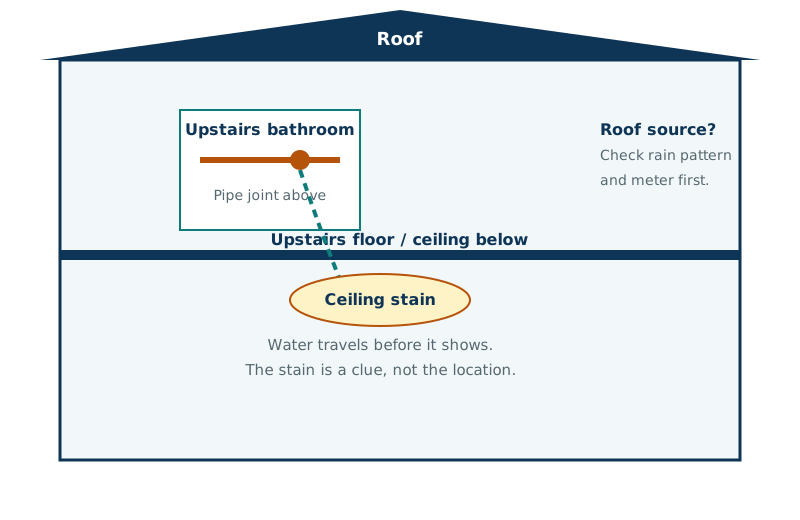
A ceiling stain is a report, not a diagnosis. It tells you water reached the ceiling, not where it came from. Homeowners often jump straight to a plumber, or straight to a roofer, and both jumps can be wrong. The useful first step is not a trade at all — it is a small set of checks that separate the three causes, so the right trade is called once, not in turn.
What the stain pattern tells you
Pattern is the cheapest diagnostic tool you have. A stain that appears after a shower upstairs, in the same place each time, points to the floor above. A stain that appears after heavy rain, and fades between storms, points to the roof or an exterior entry point. A stain that appears in humid weather, in a bathroom or a poorly ventilated room, and does not follow rain or water use, points toward condensation. None of these patterns proves a cause on its own, but together with the meter they narrow the field a lot.
Colour and texture help too, though they are easy to over-read. A yellow or brown ring usually means water has dried and returned more than once. A fresh dark patch with a soft or sagging centre usually means water is present now, and that section should not be leaned on or poked. A stain that keeps returning after painting almost always means the source is still active — paint covers a stain, it does not stop a leak.
Plumbing, roof, and condensation compared
| Cause | Meter | When it grows | Who to call |
|---|---|---|---|
| Plumbing leak upstairs | Moves with everything off | Any weather, often after upstairs use | Leak detection |
| Roof leak | Usually still | After rain | Roofing trade |
| Condensation | Still | Humid conditions | Ventilation check |
| Drain leak upstairs | Still (drains are not pressurised) | After upstairs use | Drain specialist |
The meter row is the one that matters most. A supply leak is the only cause in the table that moves the meter, because it is the only one under pressure. That is why the meter test comes before any trade is chosen: it is a free, fast check that can rule a whole category in or out. If you are unsure how to do it, the meter test guide walks through it step by step.
Simple safe checks before you call anyone
- Meter test. Everything off, read the meter, wait without using water, read again. Movement points to a supply leak.
- Timing notes. Write down when the stain grows: after rain, after a shower, in humid weather, or all the time. Two or three dated notes are worth more than a vague memory on the call.
- Floor above. Look at the room above the stain: any visible connection, any recent work, any fixture that was used just before the stain appeared.
- Sag check. If the ceiling sags, bulges, or feels soft, stay out from under it and do not poke it. Water can be held above it.
What not to do matters as much. Do not paint over the stain and wait — a painted stain hides the timing pattern the inspection needs. Do not open the ceiling to look — ceilings contain wiring, and an unguided opening creates a larger repair without narrowing the leak. Do not assume the room above is the source just because it lines up: water travels along joists, and the stain can sit well away from the entry point.
When to call detection first, a roofer, or a ventilation check
Call leak detection first when the meter moves, or when the stain grows regardless of weather and the floor above has plumbing in it. That is the plumbing-shaped pattern, and detection is built to narrow it without opening the ceiling first. Call a roofing trade first when the stain grows only after rain and the meter does not move — that pattern points to the roof or an exterior entry point, and a plumber cannot fix it. Consider a ventilation or condensation check when the stain appears in humid conditions, in a bathroom or unventilated space, with a still meter and no upstairs source.
Uncertainty is not a reason to wait. If the pattern is mixed — rain-linked and meter-moving, for example — say so on the call. A mixed pattern can mean two separate issues, or one issue misread, and the inspection is designed to separate them rather than force a single answer.
What detection gives you
Detection gives you a narrowed point and a ruled-out list, not a repair. For a plumbing source, that means a marked ceiling section to open, with the meter result, the upstairs checks, and the method results behind it. For a non-plumbing source, it means a plain statement that the supply side is ruled out, and the next trade named. Either way you leave with a direction, which is more than a painted stain or an opened ceiling ever gives you. The full process is described on the how detection works page, and the dedicated service page is ceiling leak detection.
In a single-storey home there is no floor above to check, which changes the diagnostic. The ceiling space itself becomes the first place to rule out: roof entry, condensation in the attic space, and any pipework running through it. A stain in a single-storey home that grows only after rain is even more strongly roof-shaped, because there is no upstairs bathroom to explain it. The meter test still comes first — it is the check that separates plumbing from everything else, regardless of storeys.
Ceiling stain that grows after rain in Duluth, GA
A rain-only stain is the clearest roof signal you will get, and it is worth trusting. If the stain appears after storms, fades between them, and the meter does not move, the water is almost certainly entering from outside the plumbing system. Calling detection first in that case still has value — it rules out the supply side — but the fix will be roofing, not plumbing, and the sooner that is known, the sooner the right trade can be booked.
Ceiling stain below a bathroom in Duluth, GA
A stain below a bathroom is checked as a bathroom source first, but it is not assumed to be one. The shower seal, tub and toilet connections, and any pipe joint in that floor are checked in turn, and the meter result is read alongside them. A stain below a bathroom that grows only after rain still points away from the bathroom and toward the roof, no matter how neat the alignment looks. Position narrows the search; it does not decide it.
Common questions
How can I tell if a ceiling stain is plumbing or roof?
Use timing and the meter together. A stain that grows only after rain, with a meter that does not move, points to the roof. A stain that grows regardless of weather, with a meter that moves when everything is off, points to a supply leak. Either check alone can mislead — rain and a plumbing leak can coincide — so both are done before a trade is chosen.
Can condensation really stain a ceiling?
Yes. Condensation forms where warm, humid air meets a cold ceiling surface, and over time it can stain and even damage ceiling materials. It does not move the meter, it does not follow rain, and it is usually linked to ventilation rather than to a pipe. A bathroom or a poorly ventilated room is the usual setting, and a ventilation check is the next step once plumbing is ruled out.
Should I paint over a ceiling stain while I decide?
No. Painting hides the timing pattern the inspection needs — whether the stain grows after rain, after a shower, or all the time — and it can trap moisture behind the paint. Leave the stain visible, note when it grows, and let the inspection read the pattern. Painting is for after the source is found and fixed, not before.
Does a stain directly under a bathroom always mean a bathroom leak?
No, though it is the first thing checked. Water travels along joists and surfaces before it shows, so a stain can sit well away from its entry point. The bathroom fixtures and connections are checked, the meter is read, and only then is a point marked. Alignment narrows the search; it does not decide it.
What if my ceiling is sagging?
Stay out from under it and do not poke it. A sagging ceiling can hold more water than it appears to, and it can come down without warning. Shut off the main valve if water is spreading and it is safe to reach, keep clear of wet electrics, and call. A sagging ceiling is treated as urgent even if the stain itself looks small.