 Duluth Water Leak Detection Pros
Crawl Space Moisture vs a Leak: How to Tell the Difference
Crawl space moisture in Duluth, GA, in ZIP codes 30096 and 30097, can be condensation, ground moisture, or a pipe leak — and the three look alike from below. The meter test separates a supply leak from the other two.
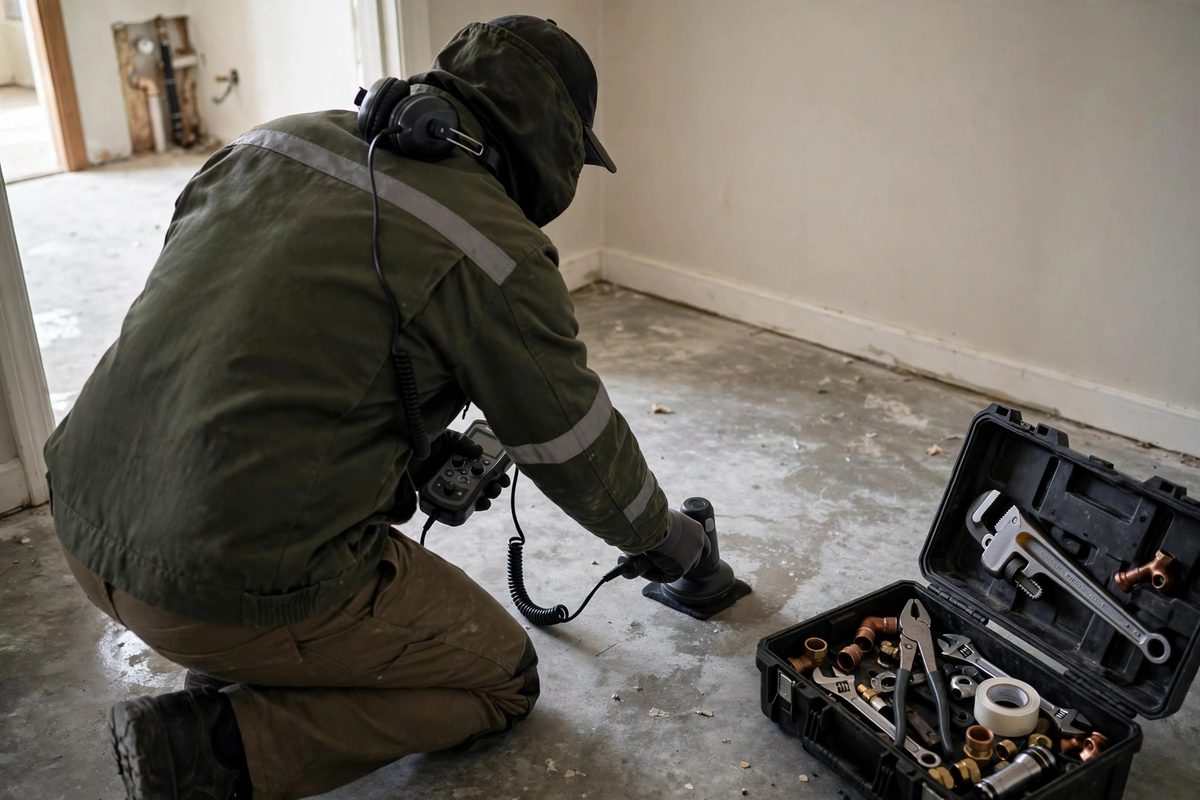
A crawl space is the hardest place in a house to read, because it is dark, hard to access, and damp for several unrelated reasons. Moisture in a crawl space does not automatically mean a pipe is leaking, and a pipe leak in a crawl space does not always make the crawl space obviously wet. That double uncertainty is why crawl space questions need the same separation as ceiling and wall questions: meter first, then causes, then narrowing.
Three crawl space moisture causes
| Cause | Meter | Pattern | Next step |
|---|---|---|---|
| Supply pipe leak | Moves | Localised wet patch, grows regardless of weather | Narrow the pipe |
| Condensation | Still | Widespread damp, humid conditions | Ventilation check |
| Ground / drainage moisture | Still | Follows rain, ground level, drainage | Drainage check |
| Drain leak | Still (drains are not pressurised) | After fixture use, near drain runs | Drain specialist |
The meter row, again, is the separator. A supply leak is the only cause that moves the meter, because it is the only one under pressure. A crawl space that is damp everywhere, with a still meter, points to condensation or ground moisture, not to a pipe. A crawl space with one wet patch, a moving meter, and a pipe run above that patch points to a leak, and the narrowing checks confirm it.
What to look for, safely
Crawl spaces can be hazardous — low clearance, wiring, pests, and standing water — so do not enter one to investigate a leak yourself. What you can do safely is note what is visible from the access point, note any musty smell in the rooms above, note whether the dampness follows rain or appears regardless of weather, and do the meter test. Those four notes, plus the meter result, are what the inspection needs. Entering a crawl space to search for a leak yourself risks injury and rarely finds the source, because water travels along joists and surfaces before it shows.
If there is standing water in a crawl space, treat it as a hazard, not as a clue to wade through. Standing water near wiring is dangerous, and standing water itself does not say whether the source is plumbing, drainage, or condensation. Note it, photograph it from the access point if you can do so safely, and call.
What detection does in a crawl space
Detection in a crawl space follows the same sequence: meter, isolation where valves allow, acoustic listening, and marking the point several checks agree on. The difference is access: a crawl space inspection needs safe access, lighting, and clearance, and the marked point may be described by its position relative to the access point and the pipe run, rather than by a mark on a finished surface. If the cause turns out to be condensation or drainage, the inspection states that plainly and names the next trade, rather than marking a pipe that is not leaking.
Crawl space moisture in Duluth, GA
For a Duluth home with crawl space moisture, the practical sequence is: meter test, pattern notes (rain, humidity, fixture use), safe observation from the access point, then call with those notes. Do not enter the crawl space to search, do not assume moisture means a pipe leak, and do not assume a pipe leak is absent because the crawl space is only damp in one season. The separation — meter, pattern, narrowing — is what decides, and it is done on site, not from above. The related service pages are underground and slab leak detection.
Ventilation and drainage: the non-plumbing fixes
When a crawl space problem turns out not to be plumbing, the fix is usually ventilation, drainage, or both — and both are trades in their own right, not plumbing work. Ventilation addresses condensation: moving air through a crawl space, reducing humidity, and preventing the damp conditions that stain materials and feed musty smells. Drainage addresses ground moisture: grading, gutters, and drainage that keep water away from the foundation and out of the crawl space. Each one fixes a different cause, and confusing them — ventilating a drainage problem, or draining a condensation problem — wastes money without fixing anything.
How to tell which one fits is, again, a matter of pattern. Widespread damp in humid conditions, with a still meter and no localised wet patch, points to ventilation. Damp that follows rain, that pools at ground level, or that tracks a slope toward the foundation, points to drainage. A localised wet patch with a moving meter points to plumbing, and that is the case detection is for. The inspection's ruling-out is what separates those three, and the referral that follows it should name the right trade, not just “someone else.”
One caution for any non-plumbing fix: do not seal a crawl space or add insulation on speculation, without knowing the cause. Sealing a crawl space that has a drainage problem can trap water inside; insulating a crawl space with a condensation problem can hide dampness without fixing it. Cause first, fix second — the same order as detection itself, applied to the whole crawl space, not just to a pipe.
After a crawl space fix: how to know it worked
After any crawl space fix — plumbing, ventilation, or drainage — the question is how to know it worked, and the answer is the same as for any leak: repeat the checks that found the problem, in the same way, and compare. If the problem was a supply leak, repeat the meter test: a meter that no longer moves with everything off is the clearest sign the leak is fixed. If the problem was condensation, check dampness in humid conditions, over time, not on a single dry day. If the problem was drainage, check after rain, not in dry weather. Each cause has its own re-check condition, and a re-check done in the wrong condition proves nothing.
Keep the re-check record with the original file: dates, conditions, meter results, and photographs from the access point. A fix that is verified by a repeated check is a closed issue; a fix that is assumed to have worked, without a re-check, is an open one. That distinction matters most in a crawl space, because it is out of sight — a problem that returns there can go unnoticed for months, and by the time it is noticed again, it has usually spread further than it needed to. Verification is cheap insurance against that silence.
One final note on crawl spaces: they reward patience and punish haste. A crawl space problem that is rushed — opened, sealed, or dried without a cause — usually returns, because the cause was never separated from the symptoms. A crawl space problem that is approached in order — meter, pattern, narrowing, referral, fix, re-check — usually stays fixed, because each step answered a question before the next step was taken. That order is the whole method, applied to the hardest room in the house, and it is worth following even when it feels slow. Slow and correct beats fast and repeated, every time.
Common questions
Does crawl space moisture always mean a pipe leak?
No. Crawl space moisture can be condensation, ground or drainage moisture, or a pipe leak, and the three look alike from below. The meter test separates a supply leak from the other two: a moving meter points to supply, while a still meter points to condensation, drainage, or a drain issue.
Should I enter my crawl space to find a leak?
No. Crawl spaces can be hazardous — low clearance, wiring, pests, and standing water — and entering one to search rarely finds the source, because water travels along joists before it shows. Note what is visible from the access point, do the meter test, and call.
What if there is standing water in the crawl space?
Treat it as a hazard, not as a clue to wade through. Standing water near wiring is dangerous, and standing water itself does not say whether the source is plumbing, drainage, or condensation. Note it, photograph it from the access point if safe, and call.
Can detection find a leak in a crawl space without opening anything?
Detection narrows to a point using the meter, isolation, acoustic, thermal, and moisture checks, with safe access to the crawl space. The marked point is described by its position relative to the access point and the pipe run. Opening, if needed, is kept to that marked point.
What if the moisture turns out not to be plumbing?
Then the inspection has still done useful work: it has ruled out a supply leak and pointed to ventilation or drainage. That ruling-out is stated plainly rather than dressed up as a location, because a false location is worse than an honest referral to the right trade.