 Duluth Water Leak Detection Pros
What Does a Moisture Reading Actually Prove?
A moisture reading in Duluth, GA, in ZIP codes 30096 and 30097, shows where water has spread — not where the leak started. The wettest spot is rarely the leak, and a moisture meter alone does not mark a point.
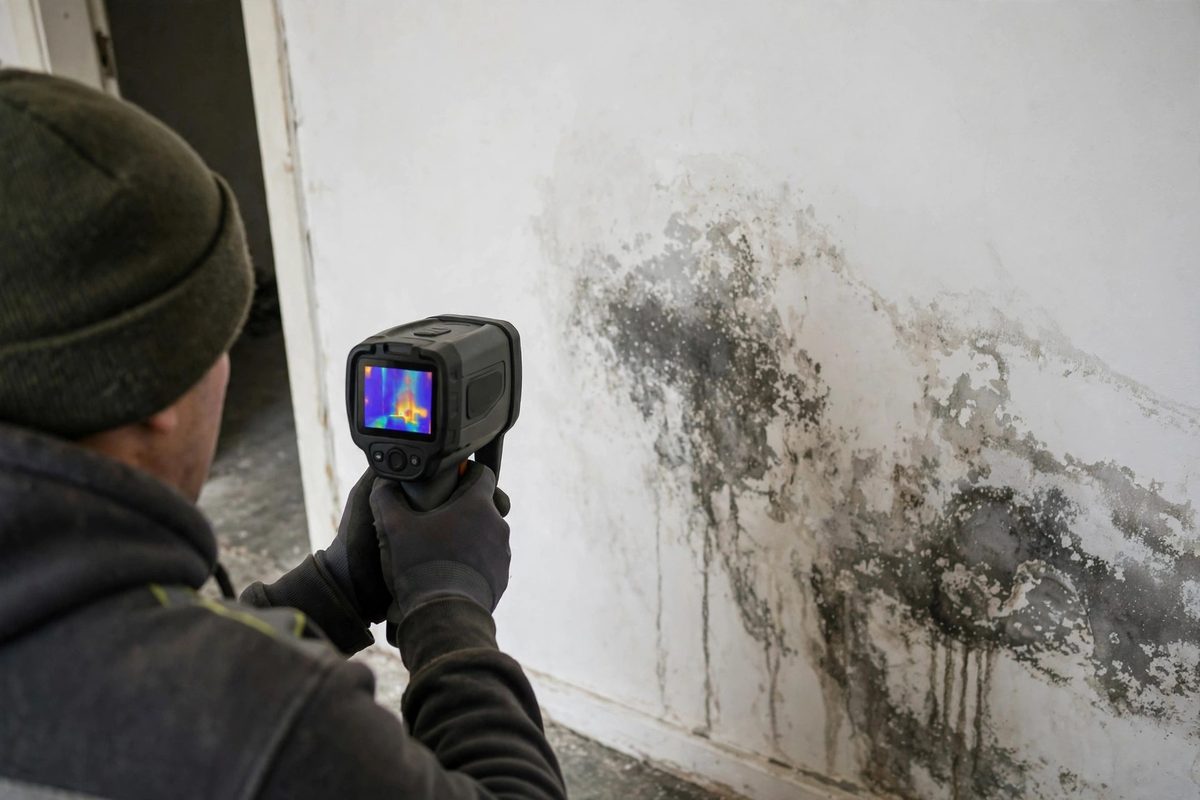
A moisture meter is a useful instrument, and it is also an easy one to overstate. It measures moisture in a material — a wall, a floor, a ceiling — at the point where it is held. It does not see a pipe, it does not see through a wall, and it does not know where water entered. Water travels inside walls, along joists, and under floors before it surfaces, so the wettest reading is often some distance from the leak. A provider who marks a leak from a single moisture reading, without a meter test or any other check, is marking dampness, not a leak.
What moisture readings do, and do not, show
| Reading | Proves | Does not prove |
|---|---|---|
| High reading in one area | Water has reached that material | That the pipe broke there |
| Low reading nearby | That material is drier | That the leak is far away — water may not have spread there |
| Readings falling over distance | A gradient of dampness | The leak's exact point — gradients follow materials, not pipes |
| Reading unchanged after repair | Material is still damp, or drying slowly | That the repair failed — drying takes time |
The last row matters after a repair. A wall that was wet does not dry the day a pipe is fixed, and a moisture reading taken too soon after repair can look like a failed repair when it is actually slow drying. Drying time depends on material, ventilation, and how much water was held, and none of those are fixed by a reading. If a reading is still high after repair, the question is whether it is falling over time, not whether it is zero.
How moisture readings fit the full inspection
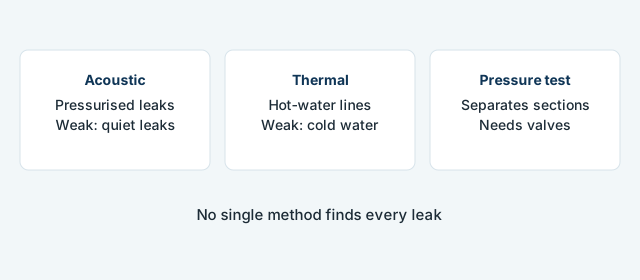
Moisture readings are one check among several, and they are most useful when combined. The meter test separates supply from everything else. Isolation narrows the section. Acoustic listening picks up a pressurised leak. Thermal imaging shows a damp or warm pattern, best on hot-water lines. Moisture readings show where damp has spread, which helps narrow the search area and helps judge how far water has travelled. The marked point is where several checks agree — not where any single reading is highest.
That combination is also why a moisture reading alone should not be sold as detection. A “moisture survey” that reports dampness without a meter test, without isolation, and without acoustic or thermal checks has not located a leak — it has mapped dampness. Mapping dampness is useful, and it is part of detection, but it is not detection on its own, and it should not be priced or described as if it were.
Questions to ask about a moisture reading
If you are shown a moisture reading, ask four questions. What was the meter result — did the meter move with everything off? What else was checked — acoustic, thermal, isolation, or moisture alone? Where do the checks agree — is the marked point where several checks point, or where one reading was highest? And what was ruled out — a roof source, condensation, a drain issue, or nothing? Those four questions separate a full inspection from a single reading, and they are worth asking before any opening is authorised.
Moisture readings in Duluth, GA
For a Duluth home, the practical takeaway is simple: treat a moisture reading as a map of spread, not as a location. The location comes from the combination — meter, isolation, acoustic, thermal, moisture — and from the ruled-out list that comes with it. If an inspection gives you a mark but cannot explain the meter result or the separation work behind it, ask for that explanation before any opening. The service pages that use moisture readings as part of the full sequence are wall, ceiling, and slab leak detection.
Moisture readings after a repair: what falling means
After a repair, moisture readings should fall over time — and “over time” is the key phrase. A wall that held water for weeks does not dry in a day, and a reading taken the day after repair will still be high. What matters is the trend: readings taken at intervals, in the same spots, with the same instrument, showing a steady fall toward normal. A falling trend means the repair is holding and the material is drying. A flat or rising trend means something is still wrong — either the repair did not address the source, or another source is present, or drying is blocked by ventilation or covering.
How to track that trend practically: ask the inspection or the repair visit to record readings with dates and positions, in writing, so later readings can be compared like-for-like. A reading without a date, a position, and an instrument note cannot be compared to a later reading, and an uncomparable reading is not evidence of anything. If you are tracking drying yourself, use the same spots and note the dates — consistency is what turns separate readings into a trend.
When to re-check is a judgement, not a fixed interval, and no interval is claimed here. In general terms, a re-check after a period of drying, with ventilation restored and coverings left off where possible, gives a clearer picture than a re-check the next day. If readings are not falling, do not assume the repair failed — ask for a re-narrow, with the meter test repeated, because a second source or a missed section is as likely as a failed repair, and the distinction matters for what happens next.
Moisture meters: pin, pinless, and what each one measures
Moisture meters come in two broad types, and knowing the difference helps you read a result honestly. Pin meters measure moisture by driving two pins into a material and measuring electrical resistance between them — they measure at a point, at the depth the pins reach, and they leave small holes. Pinless meters measure by sending a signal into a material and reading its return — they measure over an area, to a limited depth, without holes, but they are affected by material density and by anything embedded in the material, such as metal. Neither type sees a pipe, and neither type measures a leak directly; both measure moisture in a material, and both need interpretation alongside other checks.
That interpretation is where expertise matters. A pin reading in timber, a pinless reading in plasterboard, and a pinless reading in concrete are not comparable numbers, even if the meter displays them on the same scale. A competent inspection states the instrument type, the material, and the position for each reading, so later readings can be compared like-for-like. A reading without those three details — instrument, material, position — cannot be compared to anything, and it should not be treated as evidence of a leak, a repair, or a drying trend on its own.
Common questions
Does the wettest spot show where the leak is?
Rarely. Water travels inside walls, along joists, and under floors before it surfaces, so the wettest reading is often some distance from the leak. A moisture meter shows where water has spread, not where it started, and the marked point is where several checks agree, not where one reading is highest.
Can a moisture meter alone find a leak?
No. A moisture survey that reports dampness without a meter test, isolation, acoustic, or thermal checks has mapped dampness, not located a leak. Mapping dampness is useful and is part of detection, but it is not detection on its own, and it should not be described as if it were.
Why is a wall still damp after the pipe was fixed?
Because drying takes time. A wall that was wet does not dry the day a pipe is fixed, and a reading taken too soon after repair can look like a failed repair when it is actually slow drying. The question is whether readings are falling over time, not whether they are zero immediately.
What should I ask when shown a moisture reading?
Four questions: what was the meter result, what else was checked besides moisture, where do the checks agree, and what was ruled out. Those four separate a full inspection from a single reading, and they are worth asking before any opening is authorised.
Do moisture readings work on all materials?
They work differently on different materials, and readings are not directly comparable across materials — a reading in plasterboard, timber, and concrete mean different things. That is another reason readings are combined with other checks rather than trusted alone, and why a gradient across materials does not by itself mark a point.